Short answer: start with a puzzle that releases familiar food almost as easily as a bowl. Let your cat discover one quick success, count every piece within the normal daily ration, and increase the difficulty only after the current step looks comfortable. A cat that walks away is not “lazy”; the puzzle may be unfamiliar, too difficult, poorly placed, or a bad match for how that cat likes to use paws, nose, and tongue.
Food puzzles can add choice and foraging opportunity to an indoor routine, but they are not a guaranteed exercise or weight-loss device. A veterinary review of feline feeding research found that one small randomized crossover study of 19 house cats detected no difference in daily or weekly activity between bowl feeding and food puzzles. The useful question is therefore not “Does every cat need one?” but “Can this individual cat use it comfortably without losing access to the food they need?”
Begin with the bowl as your baseline
Before introducing a puzzle, measure the cat’s normal daily ration and notice how the cat already eats. Does the cat use a paw to pull food closer, push objects with the nose, lick wet food slowly, or prefer a quiet station? The Feline Veterinary Medical Association’s consensus guidance on feline feeding programs recommends customized plans that support hunting and foraging, frequent small meals, and safe solitary feeding locations—including in multi-pet homes.
Keep the first trial small. Move a measured spoonful—not an uncounted extra—from the daily ration into the easiest puzzle setting. If you are also deciding how to divide the day’s food, our guide to small meals for adult cats explains how to change timing without increasing total calories.
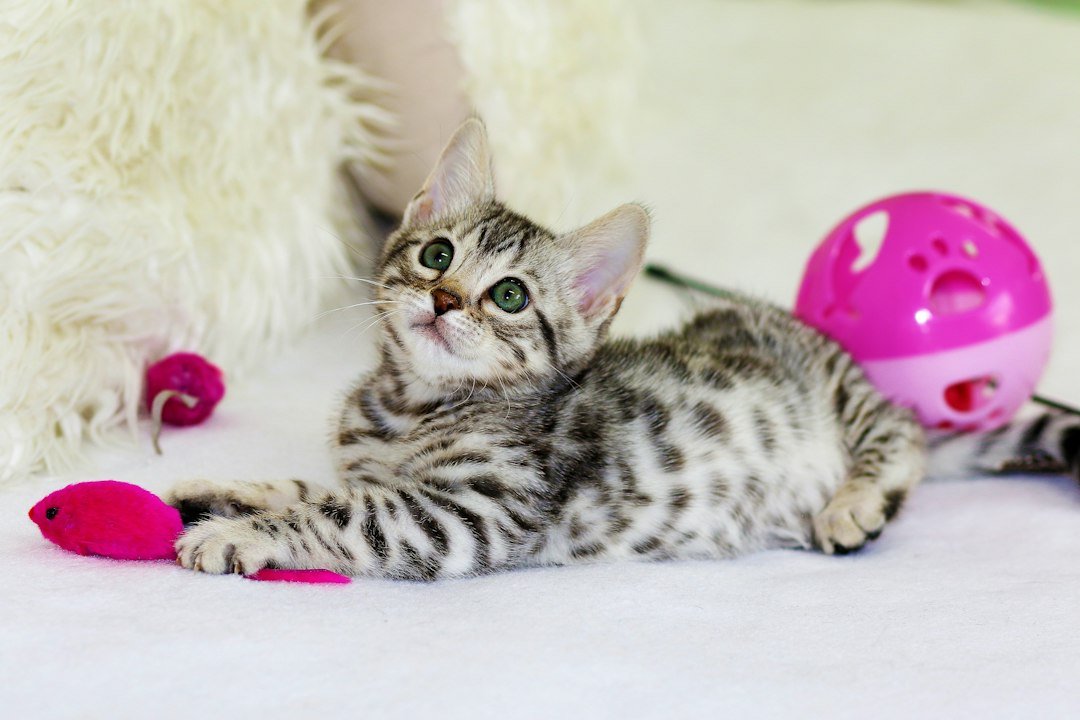
Choose the easiest match, not the cleverest puzzle
| Starter style | What the cat does | Make the first attempt easy | Useful observation |
|---|---|---|---|
| Open stationary cups or shallow wells | Licks food or lifts visible pieces with a paw | Leave wells uncovered and fill them high enough for food to be immediately visible and reachable | Does the cat use tongue, paw, or both? |
| Mobile puzzle with large openings | Pushes or rolls the object to release dry food | Use the widest opening and place several pieces beside the puzzle before one gentle demonstration | Does movement attract the cat or make the cat step away? |
| Shallow wet-food surface | Licks food from broad grooves or wells | Spread a thin, easy-to-reach portion rather than packing food into deep corners | Can the cat reach the food without awkward head or neck positioning? |
| Food placed in two or three familiar locations | Searches without manipulating a device | Keep locations obvious and easy to access | Does the cat enjoy searching more than pushing an object? |
The peer-reviewed review Food Puzzles for Cats: Feeding for Physical and Emotional Wellbeing distinguishes mobile puzzles from stationary cups and wells and recommends starting with food that is as easy to obtain as it would be from a bowl. It also notes that individual cats may prefer different ways of interacting, so one rejected design does not prove that every puzzle is unsuitable.
Use a three-step difficulty ladder
Step 1: Food beside and on the puzzle
Place a few pieces of the cat’s familiar food beside the device and leave more plainly visible on or inside it. For a rolling puzzle, use its largest opening. For a stationary puzzle, leave cups uncovered and nearly overflowing. The goal is one easy food result after a sniff, lick, nudge, or paw touch.
Step 2: One simple action releases food
After the cat repeatedly approaches and eats comfortably, reduce the loose food around the puzzle. Keep the device easy enough that one small movement releases or exposes food. Change only one variable at a time: opening size, number of covered wells, food depth, or location. If you change everything together, you cannot tell what made the task easier or harder.
Step 3: Add variety, not a test
Once the cat is succeeding, rotate between compatible stationary, mobile, wet-food, or simple search options. Do not keep increasing difficulty just because the device allows it. The veterinary review of feeding for mental and behavioral wellbeing says difficulty should match the cat’s abilities and require little effort at first; it also emphasizes choice and monitoring the total daily intake.
Read the response: curiosity, problem-solving, or frustration?
| What you see | Interpret carefully | Next step |
|---|---|---|
| Sniffs, eats nearby food, then returns to the puzzle | The cat is investigating at a workable pace | Repeat the same easy setup before making it harder |
| Paws or nudges once, food appears, and the cat continues | The action-to-food connection may be forming | Keep the same opening or well depth for several sessions |
| Stares, paws rapidly, bites the device, swats, or leaves without eating | The task may be too hard, noisy, unstable, or poorly placed | Return food to the visible edge, steady the device, or switch to a stationary style |
| Another cat or dog approaches and the cat withdraws | Competition—not puzzle ability—may be the barrier | Move the trial to a quiet, separated feeding area |
| The cat eats less overall or suddenly loses interest in familiar food too | This is not a training challenge to push through | Restore the familiar feeding method and contact the veterinary team for advice |
The 2016 veterinary review warns that an unsolvable task can create frustration and recommends staged difficulty within a broader enrichment plan. It also suggests a quiet location for nervous cats and separate puzzles for cats that might otherwise compete. In a multi-cat home, use the access map in our multi-cat resource planning guide so one confident cat does not control every food opportunity.
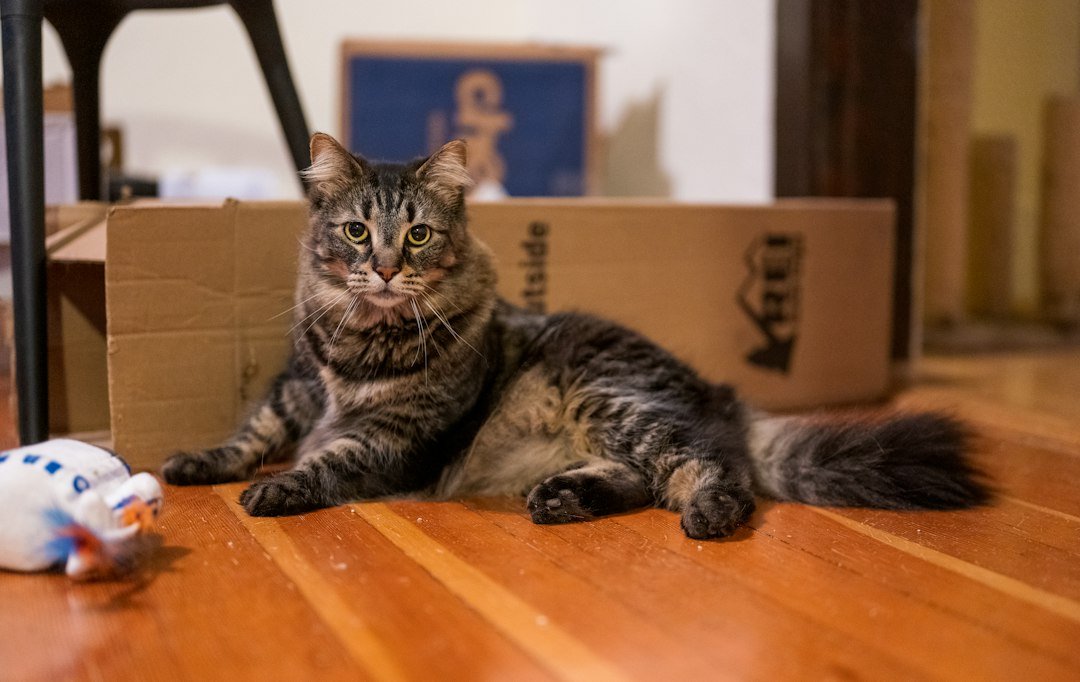
Completed example: a fictional first week
This example is hypothetical and is not a story about Ruby, Loki, or Coco. Maya is a healthy adult cat who eats a measured dry-food ration and has never used a food puzzle. She often pulls a loose toy closer with her paw but backs away from objects that rattle loudly.
| Session | Setup | Recorded response | Decision |
|---|---|---|---|
| Day 1 | One tablespoon from the daily ration; most pieces beside an open stationary tray, a few in shallow wells | Maya eats the loose pieces and removes one piece from a well | Repeat exactly; one successful reach is enough |
| Day 3 | Same tray and location; fewer pieces beside it, wells still uncovered | Maya uses a paw three times and eats the full measured portion | Keep difficulty stable for two more sessions |
| Day 5 | One well lightly covered; all other wells open | Maya eats from open wells but ignores the covered one | Remove the cover next time; the added step was premature |
| Day 7 | Open tray again, placed in the same quiet room | Maya finishes calmly | Continue the successful stationary style; no need to force a rolling puzzle |
Maya’s caregiver does not add treats on top of the ration and does not interpret the ignored covered well as failure. If treats are used briefly for motivation, they still belong in the daily calorie budget; our cat treat calorie guide shows how to account for them.
When to pause and ask the veterinary team
Keep the familiar feeding method available while learning what works. Pause the puzzle experiment if the cat’s total intake falls, the cat struggles physically, food becomes inaccessible to the intended cat, or a medical diet or medication schedule is disrupted. Cats with diabetes, kidney disease, food allergies, swallowing difficulty, dental pain, significant mobility limits, or a prescribed weight plan need an individualized setup from their veterinary team.
A sudden change in appetite is not evidence that a cat is bored with the puzzle. Return to the accepted feeding method, measure what the cat actually eats, and seek veterinary guidance. If you are changing the food itself as well as the feeding method, separate those experiments; our food-transition guide explains why changing one variable at a time is easier to interpret.
The practical takeaway
A useful puzzle feeder is not the most complicated one. It is the setup that lets a particular cat obtain a measured meal safely, shows you a clear preference, and can be made easier the moment frustration appears. Start with food in plain sight, reward the first successful interaction by keeping the task solvable, and let the cat—not the product’s maximum difficulty—set the pace.
Sources and further reading
- Feline Veterinary Medical Association: Feline Feeding Programs—Addressing Behavioral Needs to Improve Feline Health and Wellbeing
- Dantas LMS, Delgado MM, Johnson I, Buffington CAT. Food Puzzles for Cats: Feeding for Physical and Emotional Wellbeing. Journal of Feline Medicine and Surgery (2016)
- Delgado M, Dantas LMS. Feeding Cats for Optimal Mental and Behavioral Well-Being. Veterinary Clinics of North America: Small Animal Practice (2020)
- Survey of Feeding Practices and Use of Food Puzzles in Owners of Domestic Cats. Journal of Feline Medicine and Surgery (2019)
Sources checked October 30, 2026. This independent educational article was not individually reviewed by a veterinarian and does not replace veterinary diagnosis, treatment, or a prescribed feeding plan.