Short answer: many healthy adult cats can do well on one or two measured meals a day, but dividing the same daily ration into several smaller meals can better match normal feline feeding behavior. The useful question is not “How many bowls?” by itself. It is whether your cat receives the right total daily amount, eats it comfortably, and maintains a healthy body condition.
This guide compares three common approaches and shows how to test a schedule without accidentally adding calories. It is general education, not an individual diet prescription.
Why two reputable recommendations can sound different
Cornell Feline Health Center says that feeding once or twice daily is appropriate for most adult cats, while also stressing that age, health, and individual preference matter. The Feline Veterinary Medical Association’s owner guide recommends dividing the daily allowance into multiple small meals and using tools such as puzzle feeders or automatic feeders when helpful.
Those positions are not truly in conflict. Cornell describes a practical meal frequency that works for many adults. The FelineVMA guidance focuses on behavioral needs and ways to make feeding resemble a cat’s natural pattern of small, separate eating events. In either case, the calories for the entire day still need to be measured.
Compare the three common feeding patterns
| Pattern | What can work well | What can go wrong | Best question to ask |
|---|---|---|---|
| One or two measured meals | Simple routine; easy to see whether the bowl was finished | A large portion may be eaten too quickly, and long gaps may not suit every cat | Does my cat eat calmly and remain settled between meals? |
| Several small measured meals | Spreads the same daily ration across more eating opportunities; can work with an automatic or puzzle feeder | It is easy to overfeed if each “small” meal is added instead of divided from the daily total | Can I pre-measure the full day before splitting it? |
| Food available all day | May suit some cats that regulate intake and maintain an appropriate body condition | Intake is harder to track; Cornell notes that free feeding can lead to overeating in some cats | Can I tell exactly how much this cat—not the household—ate? |
Whichever pattern you choose, use a complete and balanced food appropriate for the cat’s life stage. The package feeding guide is a starting point, not a guarantee for one particular cat. Our cat-food label worksheet can help you locate the calorie statement and feeding directions before you calculate portions.
A completed example: four meals without four times the food
Hypothetical example—not Ruby, Loki, or Coco: suppose a veterinarian and the food’s calorie information have led an owner to a daily target of 180 kcal. That number is only an example, not a recommendation for your cat. The owner could divide the same total like this:
| Time | Example share | Running daily total |
|---|---|---|
| 7:00 a.m. | 45 kcal | 45 kcal |
| 12:00 p.m. | 45 kcal | 90 kcal |
| 6:00 p.m. | 45 kcal | 135 kcal |
| 10:00 p.m. | 45 kcal | 180 kcal |
The key step happens before the first meal: measure the whole day’s allowance, then divide it. Treats must come from the same calorie budget rather than sitting invisibly on top of it. If you use both wet and dry food, calculate the combined total and review our wet-versus-dry hydration guide for the separate water-intake question.
Let observations choose the next adjustment
Do not judge a schedule from one eager meow. Watch a repeated pattern for several days, keep the daily amount stable, and change one variable at a time.
| What you repeatedly observe | What it may mean | A practical next step |
|---|---|---|
| The cat bolts a large meal and immediately searches for more | The portion may be too large for one sitting, or the feeding experience may be too easy and brief | Split the same daily ration into more meals; try a simple puzzle feeder and introduce it gradually |
| The cat leaves food, returns later, and stays at a stable body condition | The cat may prefer smaller eating events | Offer smaller measured portions more often, removing perishable leftovers safely |
| Begging shifts earlier every day | The routine may be predicting food rather than proving hunger | Keep times consistent; consider an automatic feeder for one scheduled portion |
| Body weight trends upward | Total intake may exceed need even if each serving looks small | Re-measure the full day, include treats, and ask the veterinary team to review the calorie target |
| One cat waits back while another guards the feeding area | Competition may be changing who actually eats | Feed in separate, visually divided locations and verify each cat’s intake |
| You cannot tell which cat ate which food | Household totals are hiding individual intake | Use supervised meals, separate rooms, or individual-access feeders |
A sudden appetite change, repeated vomiting, or an unexpected weight change is not something to solve only by rearranging mealtimes. Contact your veterinarian so health causes and the cat’s individual calorie needs can be assessed.
Small meals in a multi-cat home
More meal times do not automatically reduce tension. The FelineVMA guide advises separate feeding stations with distance and visual separation so cats can eat privately. That also makes it easier to confirm that each cat received the intended portion. Our multi-cat resource guide explains how to map separate stations around the home.
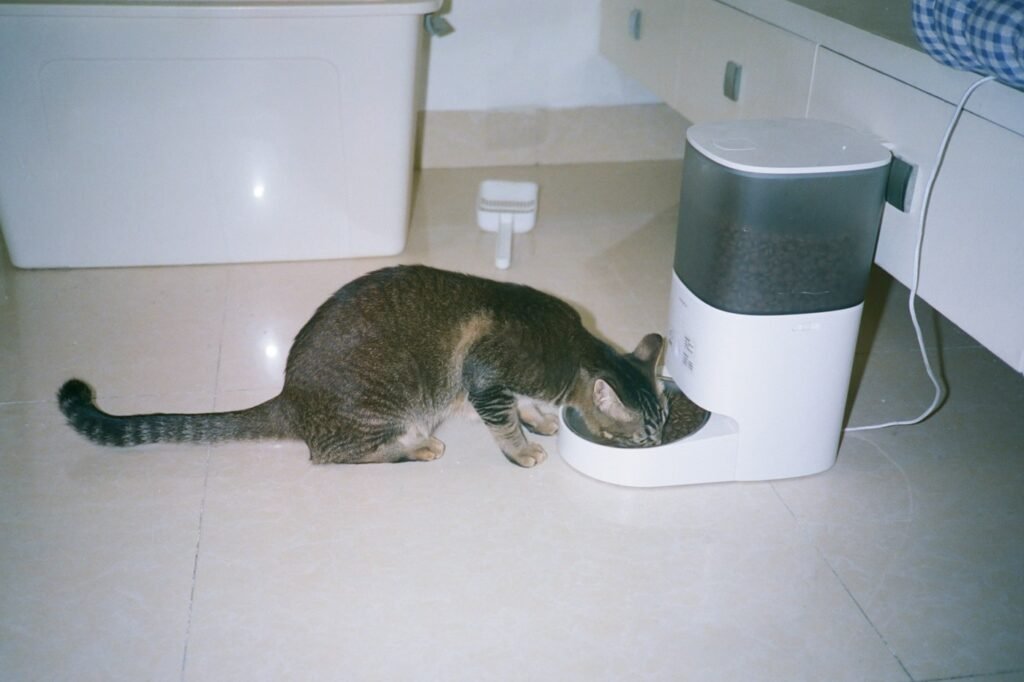
If an automatic feeder is used, test it while you are present. Confirm that it releases the intended amount and that the intended cat can approach without being displaced. A device is a scheduling tool, not proof that the right cat ate.
A seven-day meal-schedule trial
- Write down the current daily amount, including treats.
- Choose one change: split the ration into three or four meals, or move from free feeding to measured meals.
- Pre-measure the complete daily allowance each morning.
- Record meal time, amount offered, amount left, and any competition.
- Check the cat’s comfort and routine; do not add extra portions because the bowl looks small.
- Weigh the cat at consistent intervals using the same method, and discuss concerning changes with the veterinary team.
- After seven days, keep, adjust, or stop the trial based on the pattern—not one isolated meal.
Store opened food correctly during the trial; our guide to safe cat-food storage covers wet and dry food separately.
The bottom line
For many healthy adult cats, one or two measured meals are a reasonable baseline. Several smaller meals can be a useful refinement when they improve comfort, activity, or individual monitoring. The safest experiment is simple: keep the day’s total fixed, split it differently, observe the cat in front of you, and involve your veterinarian when health, weight, or appetite is changing.
Sources and further reading
- Cornell Feline Health Center: How often should you feed your cat? (edited 2024).
- Feline Veterinary Medical Association: How to Feed a Cat—Addressing Behavioral Needs (owner brochure based on the AAFP consensus statement).
- World Small Animal Veterinary Association: Frequently Asked Questions and Myths (nutrition guidance).
Sources checked October 7, 2026. This article was written as general owner education and has not been individually reviewed by a veterinarian.