Short answer: a useful starting size is a rectangular litter box about 1.5 times your cat’s length from the tip of the nose to the base of the tail. Measure the usable inside floor—not the outside footprint. Your cat should be able to enter, turn, dig, squat, and leave without being pressed against the walls.
A bigger box is not a cure for every toileting problem, and one number cannot replace the cat’s actual behavior. But size is easy to overlook because many products are described as “large” without showing how much interior space remains after sloped sides, a hood, or an entry tunnel.
Measure the cat, then do one simple calculation
The AAHA/AAFP feline life-stage guidance and the AAFP/ISFM house-soiling guidelines recommend a box approximately 1.5 times the cat’s length. The house-soiling guideline defines that measurement from nose to the base of the tail—not to the tail tip.
- Wait until your cat is standing naturally rather than stretched or curled.
- Estimate or measure from the nose to the point where the tail begins.
- Multiply that length by 1.5.
- Compare the result with the box’s inside floor length.
For example, if a cat measures 46 cm from nose to tail base, the starting target is 69 cm: 46 × 1.5 = 69 cm. An 18-inch cat gives a 27-inch target. The calculation does not prescribe one brand or shape; it gives you a minimum comparison point when labels such as “XL” are vague.
Outside dimensions can hide a small usable floor
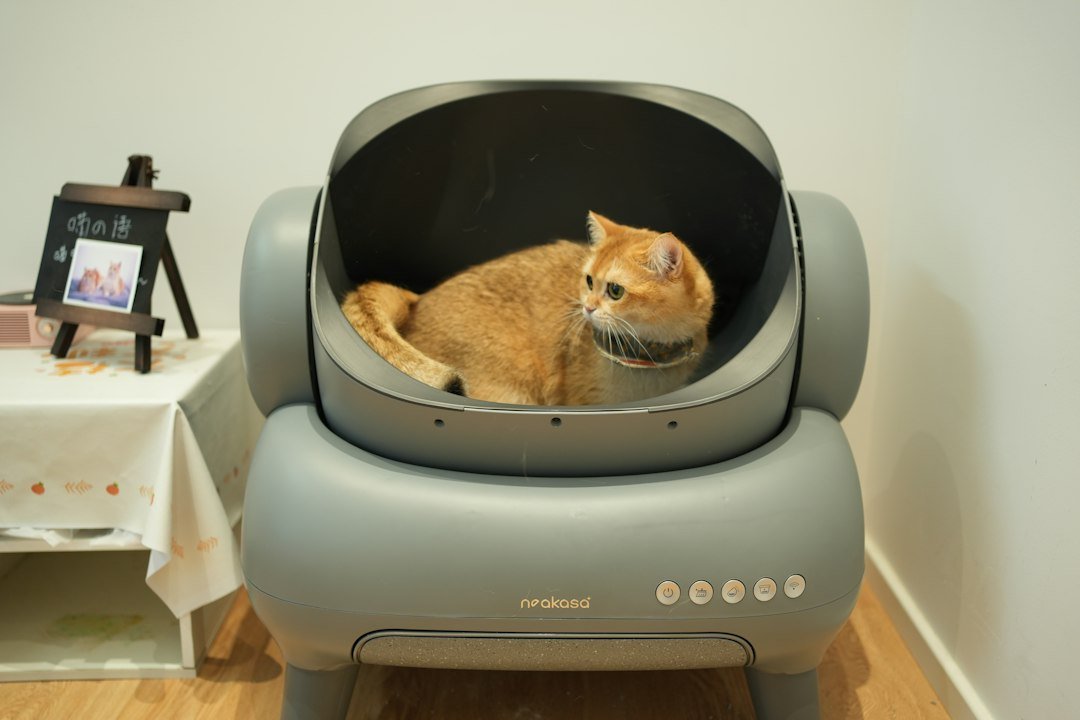
Measure where the paws actually stand. A box that is 70 cm long on the package may have a much shorter interior if the walls slope inward. Covered boxes, automatic units, and furniture enclosures can lose additional space to a hood, rake, drum, doorway, or internal mechanism.
Do not assume that a cat entering the box proves the fit is comfortable. Watch whether the cat can turn without folding tightly, whether the nose or rear repeatedly touches a wall, and whether digging and covering happen without the cat standing half outside.
Match the entrance to mobility, not just litter scatter
High sides can help contain litter or urine from a cat that eliminates while standing, but the entrance still has to be comfortable. AAHA notes that kittens and senior cats may need lower edges, and Cats Protection likewise recommends low sides for elderly cats and cats with mobility difficulties.
A useful compromise can be high walls with one smooth, low doorway. The opening should not have sharp cut edges or force the cat to jump. If your cat pauses before stepping in, climbs with one leg at a time, catches a paw, or stops using a formerly accepted box, consider mobility and pain—not stubbornness. A sudden change deserves veterinary discussion.
Choose by the problem you are solving
| What you observe | What the box may be asking of the cat | One practical next step |
|---|---|---|
| The cat’s body touches two sides while turning | The usable floor may be too short or narrow | Measure nose-to-tail-base length and compare a larger rectangular option |
| The cat enters but leaves the rear outside | There may not be enough room to position fully | Offer a longer open box without removing the familiar one |
| Litter is scattered after energetic digging | The cat may have room to dig but low walls contain little | Keep a roomy floor and add higher walls or a mat; do not solve scatter by shrinking the box |
| A senior cat hesitates or catches a paw at entry | The entrance may require too much lifting or jumping | Try a low, smooth entry while preserving enough floor space |
| The cat uses an open box but avoids a covered one | The hood may reduce space, visibility, or exit choice | Keep an open option and compare use rather than forcing the covered box |
| Repeated straining, crying, blood, or tiny/no urine clumps | This may be a medical problem, not a box preference | Contact a veterinarian promptly; little or no urine with distress is an emergency |
Open or covered? Preserve a choice while you compare
There is no universal winner. Cats Protection notes that individual cats differ and suggests comparing options when you are unsure. A covered box can give visual privacy, but its hood can reduce usable height and length, retain odor, and limit exits. An open box makes the interior and the cat’s posture easier to observe but may scatter more litter.
If you want to test a larger or open design, do not abruptly remove a box the cat reliably uses. Keep location, litter, and cleaning routine as similar as possible and change only the box feature you are comparing. The method in Should You Change Cat Litter All at Once? Try a Two-Box Test can also be used to avoid changing the container and substrate at the same time.
A completed example: measuring before buying
This is a hypothetical example, not an account of Ruby, Loki, or Coco. Maya is an adult cat using a covered box labeled “large.” Her caregiver notices that she steps in, turns tightly, and sometimes leaves the front paws outside while eliminating. There is no straining, blood, vocalization, appetite change, or sudden behavior change.
| Check | Finding | Decision |
|---|---|---|
| Cat length | 44 cm from nose to tail base | Starting target: 44 × 1.5 = 66 cm |
| Current box label | Advertised length is 64 cm | Do not decide from the label alone |
| Usable inside floor | Only 52 cm because the back and front walls slope inward | The box falls well short of the 66 cm comparison target |
| New option | Open rectangular tray with 70 cm of flat interior length and a manageable entry | Place it beside the current box with the same familiar litter |
| Seven-day observation | Maya chooses the larger tray for most eliminations and turns without touching the sides | Keep both a little longer, then phase out the less-used box only if use remains consistent |
Size still depends on location, number, and cleanliness
One oversized box in a blocked or noisy location does not replace multiple accessible toileting choices. AAHA recommends boxes in different quiet, convenient locations and gives the familiar starting point of one box per cat plus one additional box. For a household-level layout review, see Three Cats, Three Sets of Needs.
A larger box also needs regular scooping. It should not become an excuse to wait longer between cleanings. Our daily scoop-and-observe routine shows how to clean while noticing changes in urine, stool, frequency, and box use.
Know when measurement is not the next step
A cat that strains, makes repeated trips, cries while urinating, produces blood, licks the genital area frequently, or suddenly toilets outside the box needs veterinary assessment. Cornell’s feline lower urinary tract disease guidance states that an obstructed cat may pass little or no urine and become increasingly distressed. Urethral obstruction is an absolute emergency requiring immediate veterinary treatment, with male cats at increased risk.
Do not buy a larger box and wait to see whether unproductive straining improves. Box design matters, but it cannot rule out urinary disease, constipation, arthritis, pain, or another medical cause.
The practical takeaway
Measure your cat from nose to tail base, multiply by 1.5, and compare that number with the flat interior length. Then watch the whole movement: entry, turning, digging, squatting, covering, and exit. Keep the familiar box during a comparison, make one change at a time, and treat sudden or painful toileting changes as medical—not as a shopping problem.
Sources and further reading
- AAHA/AAFP Feline Life Stage Guidelines: General Litter Box Considerations
- AAFP and ISFM Guidelines for Diagnosing and Solving House-Soiling Behavior in Cats
- Feline Veterinary Medical Association: Cat Friendly Practice Guide
- Cats Protection: Cats and Toileting
- Cornell Feline Health Center: Feline Lower Urinary Tract Disease
Sources checked November 6, 2026. This independent educational article was not individually reviewed by a veterinarian and does not replace veterinary diagnosis or treatment.
Featured image: kitten beside scattered cat litter. Illustrative stock photo—not Ruby, Loki, or Coco. Photo: Jozsef Hocza / Unsplash License.