Short answer: a laser pointer can start a lively chase, but it should not be the whole game. Keep the beam away from eyes, move it only across safe floor-level routes, and finish by directing your cat to a real toy or a small food reward they can physically catch.
That final catch is the important part. A moving dot can trigger stalking and pouncing, but it disappears the moment the button is released. The American Association of Feline Practitioners’ Cat Friendly Homes guidance recommends allowing cats to capture the “prey” at the end of play and suggests ending laser play where a hidden treat or piece of kibble can be found. Cats Protection takes a more cautious position: its 2025 environmental-enrichment guide says laser toys can frustrate cats when nothing can be caught.
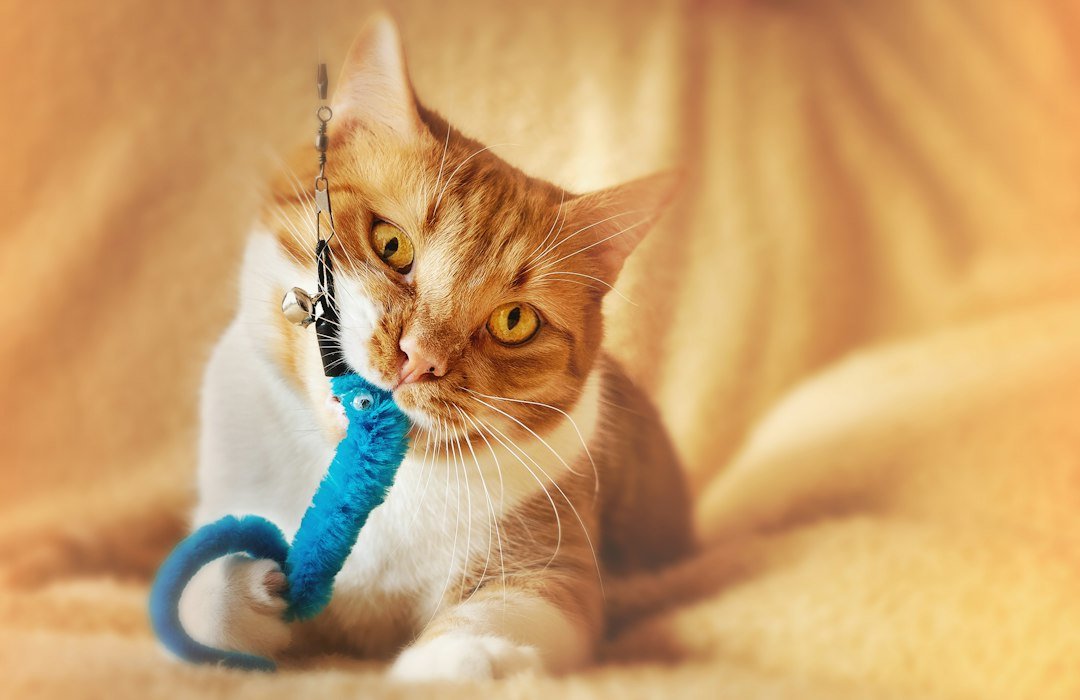
What the red dot cannot provide
Good interactive play has a rhythm: notice, stalk, chase, pounce, grab and pause. A laser can cover the middle of that sequence very effectively, but it offers no texture, weight or resistance at the end. That does not prove every cat will become frustrated. It does mean the owner needs to supply the missing finish.
Two survey studies add a useful reason for caution. In the first, guardians who used laser play more frequently also reported more repetitive behaviours such as chasing lights or shadows and fixating on reflections or a particular toy. A second survey using a different recruitment method found similar associations. These were cross-sectional, guardian-reported studies, so they show correlation—not that laser pointers caused the behaviours. Read the first study abstract and the replication abstract for the authors’ exact limits.
Choose the tool by the finish it offers
| Play tool | Can the cat catch it? | Useful role | Main watch-out |
|---|---|---|---|
| Laser pointer | No | Brief chase or transition into another game | Must lead to a real catch; never aim near eyes |
| Wand toy | Yes | Stalk, chase, pounce and grab | Supervise and store strings or loose parts after play |
| Soft toss toy | Yes | Short solo chase and batting | Choose a size and construction that cannot be swallowed |
| Food puzzle | Yes—the food is the result | Searching and problem-solving at the cat’s pace | Count the food as part of the daily ration |
A three-part laser session
1. Prepare the landing before the chase
Place a small kicker toy, mouse toy or a few pieces of the cat’s usual food on the floor before switching on the laser. Clear slippery rugs, breakable objects and routes that end at stairs or furniture edges. Decide where the dot will finish so you are not improvising while your cat is moving quickly.
Check the product label, and keep the beam away from every person’s and animal’s eyes. The U.S. Food and Drug Administration’s laser FAQ explains that the eye can focus a laser beam onto a small, intense retinal spot and advises never aiming a pointer at anyone. Avoid mirrors and shiny surfaces, and do not send the dot up walls where a cat may jump or twist unsafely.
2. Keep the route low, short and winnable
Move the dot like small prey rather than shaking it continuously: a short dash, a pause behind a chair leg, then another short dash. Let your cat choose whether to follow. Panting, repeated slipping, frantic collision with furniture, fear or disengagement are reasons to stop—not prompts to make the dot faster.
3. Hand the game over to something real
Slow the dot as it approaches the prepared toy or food. Hold it there, switch it off as the cat reaches the target, and allow time to grab, bite, eat or simply stand over the “catch.” If using a wand, continue with a few catchable movements and then let the toy go still. Our wand-toy safety guide covers supervised play and storage after the session.
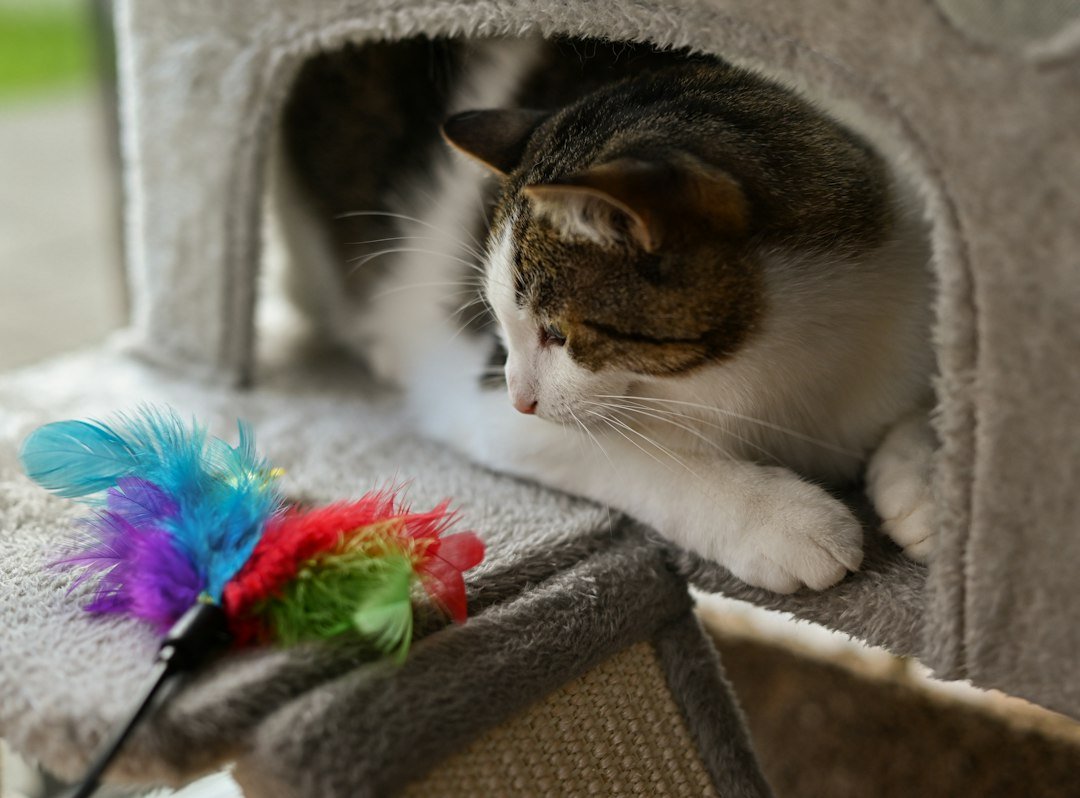
A completed example: observe the ending
This is a hypothetical example, not an account of Ruby, Loki or Coco. The point is to record what happened after the dot disappeared, because the ending helps decide whether the setup suits that individual cat.
| Moment | What the owner did | What the cat did | Next decision |
|---|---|---|---|
| Start | Placed a soft mouse and three pieces of the cat’s usual kibble on a clear rug | Watched the inactive pointer, then approached the first slow movement | Continue at floor level |
| Middle | Used two short passes with pauses | Stalked, pounced twice and remained coordinated | Begin slowing the chase |
| Finish | Moved the dot onto the mouse, switched it off and nudged the mouse once | Grabbed the mouse, then ate the kibble | Session finished successfully |
| Two minutes later | Observed without restarting | Groomed and settled; no searching for reflections | Repeat another day, not immediately |
You can use the same four moments—start, middle, finish and two minutes later—in the cat play observation log. Record only what you can see. “Searched under the chair for three minutes” is more useful than guessing that a cat felt disappointed.
When to put the laser away
Choose a fully catchable toy instead if your cat continues scanning floors or walls after the session, repeatedly chases reflections outside play, becomes hard to redirect, appears frightened, or stays highly aroused after the real-toy finish. A single odd moment is not a diagnosis. A new, frequent or escalating behaviour deserves a discussion with your veterinarian, especially if it disrupts eating, sleeping, grooming or normal interaction.
Stop using the device immediately if the beam may have entered an eye. If you suspect an eye injury or notice squinting, redness, cloudiness, unequal pupils or a change in vision, contact a veterinarian promptly. Do not test the eye again with the pointer.
A better default for many cats
If you are buying one interactive toy, a well-made wand is usually the simpler choice because the cat can stalk and capture it. The RSPCA’s wand-play activity recommends unpredictable movement, occasional catches and a captured toy at the end. For cats that prefer food-based exploration, start with an easy setup from our puzzle-feeder guide.
The practical decision is not “laser: good or bad?” It is: Can this cat finish the game calmly with something real? If yes, a very short laser lead-in may fit. If no—or if the cat keeps hunting for light after the session—put the pointer away and use a toy that can be caught from the first pounce to the last.
Sources and further reading
- Cat Friendly Homes: Playing With Your Cat — capture at the end of play and laser-to-reward transition guidance.
- Cats Protection: Environmental Enrichment (2025) — welfare guidance on play, catchable toys and laser frustration.
- Kogan et al.: Laser Light Pointers for Use in Companion Cat Play (2021) — cross-sectional survey and stated limitations.
- Kogan et al.: Associations Between Laser Light Pointer Play and Repetitive Behaviors (2022) — follow-up survey using a different recruitment method.
- U.S. FDA: Frequently Asked Questions About Lasers — beam and eye-safety information.
- RSPCA: Play Time With Cats — wand play and a successful catch at the end.
Source pages were checked on 18 November 2026. This owner-facing educational guide was not presented as veterinary review and cannot diagnose an individual cat.
Featured photograph: illustrative stock photo; not Ruby, Loki or Coco. Photo by Piotr Musioł on Unsplash, used under the Unsplash License.