Short answer: wand toys can be useful for interactive play when an adult is actively holding the toy, watching the cat, and storing it immediately afterward. Loose string, yarn, ribbon, dental floss, tinsel, rubber bands, and damaged toy attachments should never be left within reach.
The important distinction is not simply “string toy” versus “safe toy.” It is whether the cat can swallow, chew through, or become tangled in a long flexible piece—and whether a person is close enough to stop the session before that happens.
The play-and-put-away rule
Use an interactive toy as a shared activity, not as something to leave on the floor. Before play, check the cord, knot, feathers, fabric, bell, and handle. During play, keep the attachment moving away from the cat like prey and allow a brief catch at the end. When the cat walks away, starts chewing the line, or the session ends, trade for a safe toy or small food reward, inspect the wand again, and put it in a closed cupboard.
This matches guidance from the Feline Veterinary Medical Association’s Cat Friendly Homes program: interactive play can mimic hunting, but string-like materials and loose pieces can be swallowed and should be put away after play. The same guidance says a cat who walks away is finished; play should not be forced.
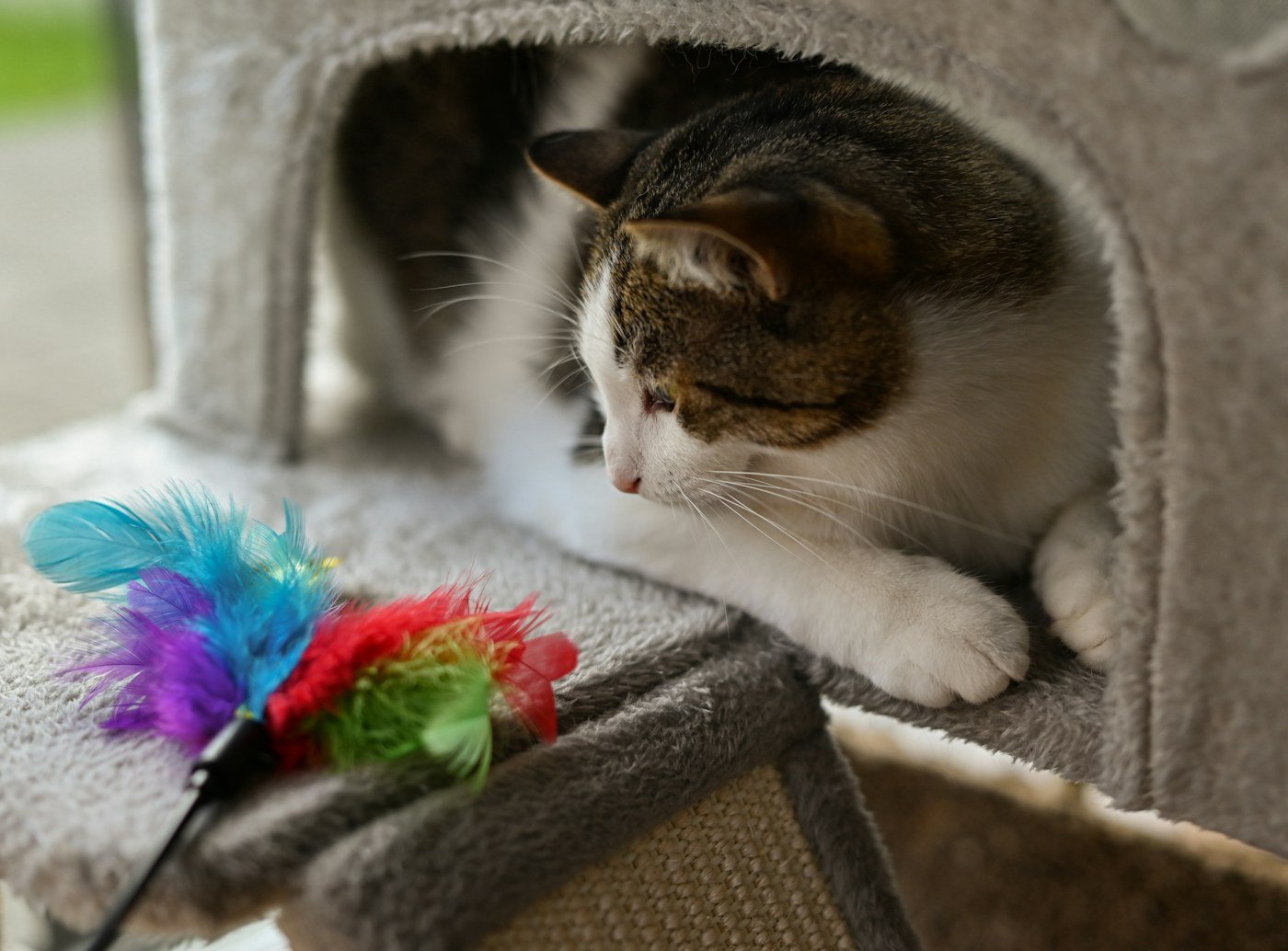
Same object, different decision
| What you see | Decision now | Why |
|---|---|---|
| Intact wand in your hand; cat is stalking or pouncing | Continue a short supervised session | You can control the line and stop chewing or tangling |
| Wand or cord left on the floor after play | Pick it up and store it in a closed place | Unsupervised access removes the safety control |
| Frayed cord, loose feather, cracked connector, or missing bell | Retire the toy | Small or linear pieces can be swallowed |
| Household yarn, ribbon, floss, tinsel, elastic, or rubber band | Secure it; do not offer it as a toy | These are easy to swallow and are not designed for cat play |
| A piece is missing or swallowing may have occurred | Call a veterinarian promptly | Waiting for obvious illness can lose valuable time |
What a safe supervised session looks like
1. Inspect before the first pounce
Run your fingers along the attachment and cord. Tug gently at knots and connectors. If anything is frayed, loose, or small enough to detach, do not begin. A toy that was intact yesterday may not be intact today.
2. Keep the “prey” on the floor or just above it
Long, high jumps are not required for satisfying play. Drag the toy behind a box, pause near a table leg, or make short unpredictable movements. For an older cat or a cat with limited mobility, slower movement and watching can still be part of play. Never use hands or feet as the target.
3. Let the cat catch it
Build in brief catches instead of keeping the toy permanently out of reach. Cat Friendly Homes recommends allowing a cat to capture the “prey” at the end of a play session. If the cat walks away, take that as the end rather than restarting the chase.
4. Interrupt chewing without a tug-of-war
If the cat begins working the cord or attachment toward the back of the mouth, stop moving it. Avoid pulling against the cat. Offer a safe toss toy or a small food reward a short distance away, then remove and inspect the wand once the cat disengages.
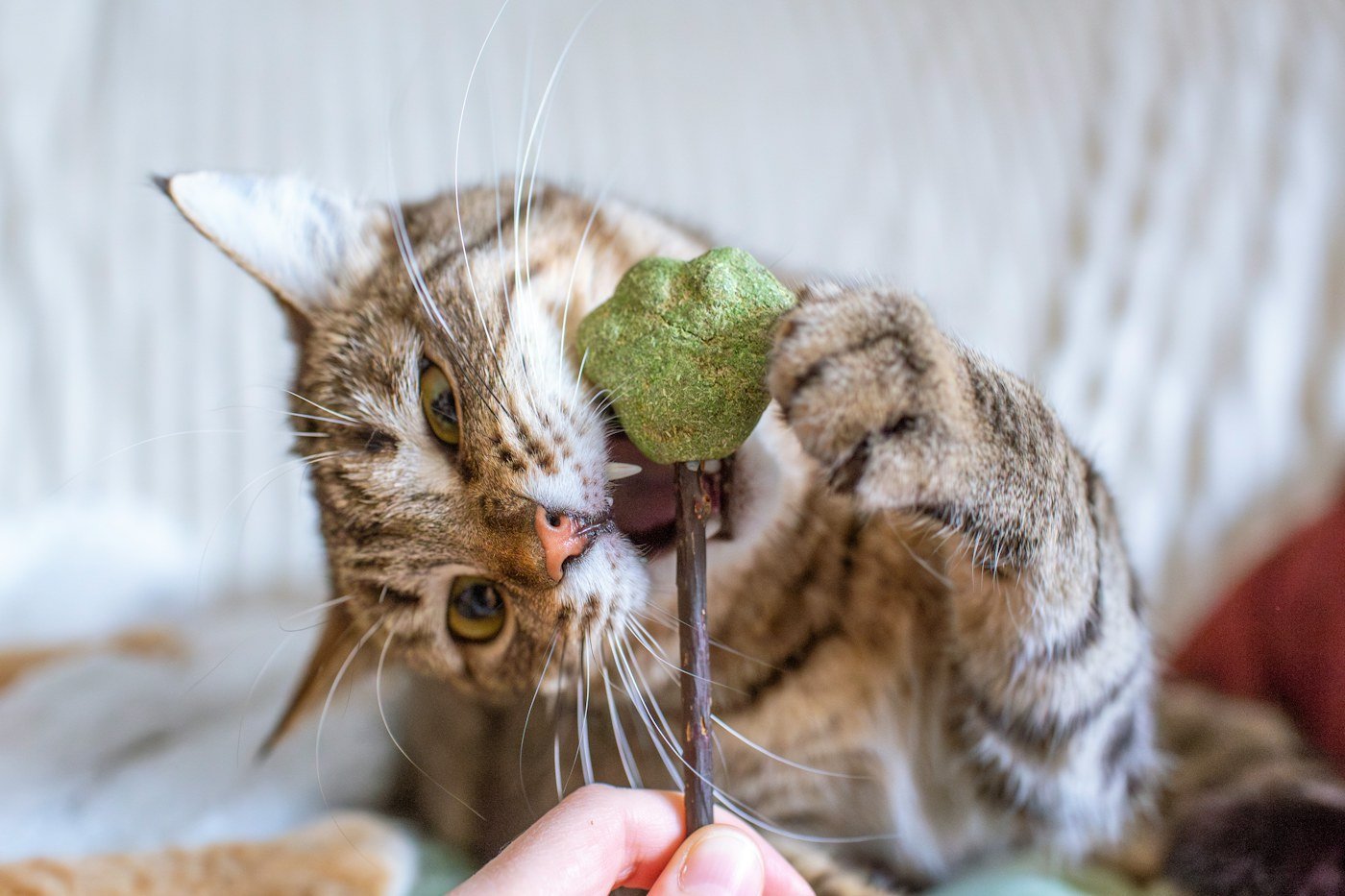
A completed example: seven minutes from cupboard to cupboard
This is a hypothetical example, not an account of Ruby, Loki, or Coco.
- 6:00 p.m.: The caregiver checks the cord, knot, and feather bundle. Nothing is loose.
- 6:01: The toy moves along the floor and pauses behind a box. The cat watches, crouches, and pounces.
- 6:04: The cat catches the toy twice. On the third catch, the cat starts chewing the attachment.
- 6:05: The caregiver stops the toy, tosses a soft mouse nearby, and removes the wand after the cat lets go.
- 6:06: A second inspection finds one feather bent but firmly attached. The caregiver decides to retire it rather than wait for a failure.
- 6:07: The wand goes into a closed cupboard and the session is noted as “interested, three catches, chewing ended session.”
That final note can be added to the Cat Play Observation Log. Over several sessions, it can reveal whether a particular attachment encourages stalking, chewing, or disinterest—and help you choose a safer style next time.
Observation to next step
| Observation | Next step |
|---|---|
| Watching, crouching, or tail tip moving | Move the toy away in short bursts; do not push it into the cat’s face |
| Pouncing and releasing normally | Continue briefly and include another catch |
| Chewing the cord or trying to swallow the attachment | Stop movement, trade calmly, remove the toy, and inspect it |
| Walking away or grooming | End the session and store the toy |
| Hiding, limping, sudden reluctance to move, or a marked change from usual play | Stop and contact your veterinary team for individual advice |
If string may have been swallowed
Treat a missing length of string, yarn, ribbon, floss, or cord as a veterinary question even if the cat still looks comfortable. Cats are particularly prone to obstruction from linear foreign bodies. The Merck Veterinary Manual explains that one end can become anchored while intestinal movement draws the rest farther along, bunching and potentially injuring the intestine.
Do not pull visible string from the mouth or from under the tongue. Merck specifically warns that pulling an embedded linear foreign body can cause perforation. Do not pull string protruding from the anus either; call a veterinarian or emergency clinic for instructions. Possible obstruction signs vary, but vomiting, refusal to eat, lethargy, diarrhea, abdominal pain, or collapse require prompt veterinary attention. A witnessed or suspected swallowing event is enough reason to call—do not wait for every sign to appear.
Make storage part of the play area
A high shelf is not always enough if a cord dangles over the edge. Use a closed drawer, lidded box, or cupboard near the place where play happens. Store household sewing supplies, gift ribbon, hair elastics, floss, and tinsel with the same care. During your next room check, add these items to the route in the Cat-Friendly Home Checklist.
The simple rule is: inspect, play together, allow a catch, trade if chewing starts, inspect again, and put the toy away. The goal is not to remove every exciting game. It is to keep the exciting part shared—and the swallowable part inaccessible.
Sources and further reading
- Feline Veterinary Medical Association, Cat Friendly Homes: Playing With Your Cat — interactive play, allowing a catch, avoiding string-like materials, and storing toys with loose pieces.
- Feline Veterinary Medical Association, Cat Friendly Homes: Preventing Unwanted Behaviors — short interactive play, wand alternatives to hands and feet, and adapting play for older cats.
- Merck Veterinary Manual: Gastrointestinal Obstruction in Small Animals — linear foreign-body risks, possible signs, and the warning not to pull an oral linear foreign body.
Sources checked October 12, 2026. This article is general educational information and has not received individual veterinary review. Your veterinarian can advise on your cat’s age, mobility, health history, and any suspected swallowing event.
Photo credits: Featured image by Piotr Musioł; body images by Anna Krylova and Tatyana Rubleva. All via Unsplash under the Unsplash License. These are illustrative stock photographs and do not depict Ruby, Loki, or Coco.