Short answer: a cat that bites during petting may have reached a contact threshold rather than “changed its mind for no reason.” End the interaction at the first small signal—such as a tail-tip flick, body tension, ears turning back, a head turn toward your hand, or skin twitching—and let the cat choose whether to return. Keep the next session shorter, slower, and focused on locations the cat already accepts.
A new or unusually intense reaction is different. If a cat suddenly resists touch, reacts to one exact area, moves differently, hides more, overgrooms, scratches intensely, or shows appetite or litter-box changes, contact a veterinarian. Pain or illness can make ordinary handling uncomfortable, and a behavior plan should not be used to push through possible pain.
The bite is often the last signal, not the first
Cornell’s guide to feline aggression explains that cats may show dilated pupils, tail lashing, and ears moving backward before a petting-related bite. The exact reason is not always known; possible explanations include overstimulation and the cat attempting to control when contact ends.
That makes the useful question “What happened just before the bite?” rather than “Why did my cat attack out of nowhere?” Watch the cat’s whole body, the location of your hand, the number and speed of strokes, and whether the cat still has an easy exit.
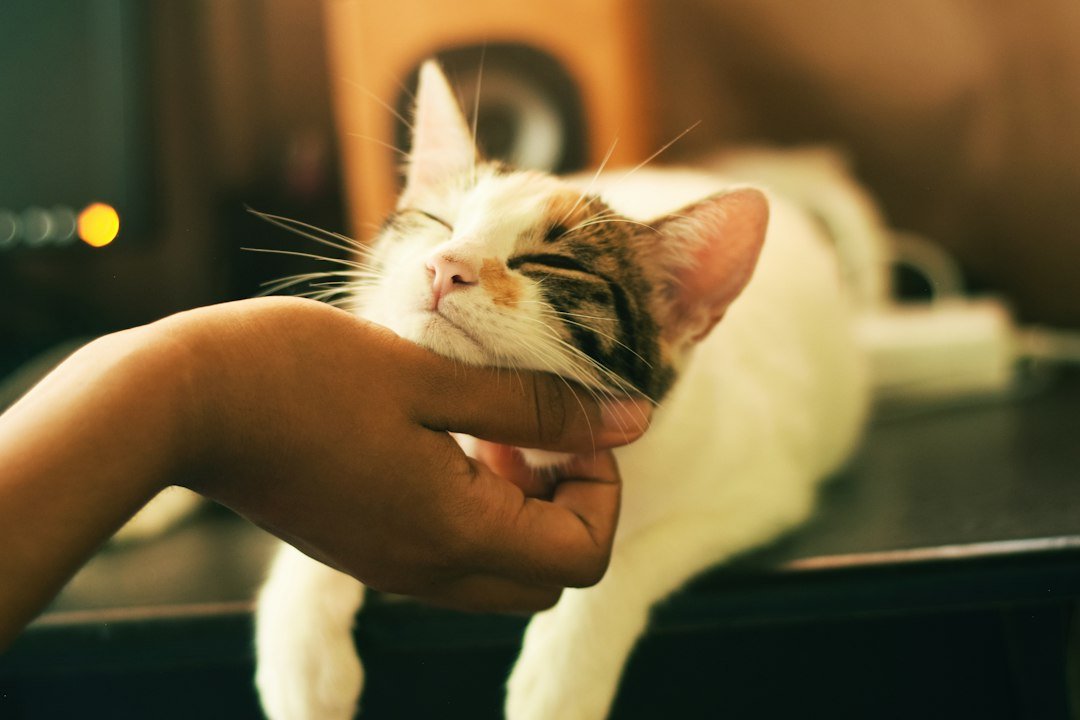
Use a consent pause: touch, stop, observe
The Feline Veterinary Medical Association’s training guidance for biting with petting recommends slow, short interactions with periodic pauses. It notes that many cats prefer contact around facial scent-gland areas and may object when petting is too long, fast, vigorous, or directed at an unwanted location.
- Wait for the cat to approach or remain comfortably beside you.
- Stroke once or twice over a familiar accepted area, usually from the side rather than reaching over the cat.
- Stop with your hand still and away from the mouth.
- If the cat rubs into the hand, stays loose, or clearly requests more, offer another short round.
- If the cat turns away, moves, stiffens, watches the hand, flicks the tail, rotates the ears, or pauses purring, end the session and provide space.
This is not a test that the cat must pass. The pause gives the cat control and gives you a readable decision point before contact becomes overwhelming.
Match the signal to the next step
| What you observe | What it may mean | What to do next |
|---|---|---|
| The cat approaches, rubs the face on your hand, and remains loose after one or two strokes | Brief contact is currently welcome | Pause, then continue only if the cat asks again |
| The tail tip flicks, ears rotate sideways or back, skin twitches, or the cat turns to watch your hand | The comfort threshold may be approaching | Stop touching immediately and allow an unobstructed exit |
| The cat tolerates head and cheek contact but reacts to belly, feet, lower back, or tail base | Location may matter more than total duration | Avoid that area; do not keep checking whether the answer changed |
| The cat grabs and bunny-kicks a moving hand during play | Play behavior may be directed at the hand rather than petting being the main trigger | End hand play and redirect future play to a distance toy |
| Touch sensitivity is sudden, stronger, or limited to one exact spot | Pain, skin disease, injury, or another medical issue may be involved | Stop testing the area and arrange veterinary advice |
The FelineVMA also warns that cats may bite or scratch when pain or illness makes human contact uncomfortable, and that physical punishment is never appropriate. Punishment can add fear to an already difficult interaction and does not teach a safer way to end contact.
Start with the safest, most predictable touch
Begin where the individual cat has already shown comfort. FelineVMA guidance suggests petting from the side and initially using the temporal area between the ears and eyes, which is farther from the mouth than some other facial areas. Avoid assuming that an exposed belly is an invitation to rub it. A cat can lie on its back while relaxed and still prefer that the belly remain untouched.
Keep your hand movement slow and consistent. Do not restrain the cat, block the escape route, pull the cat back after it moves away, or turn a brief accepted interaction into picking up and holding. Cats Protection’s cat-petting guidance recommends stopping if the cat moves away or shows anxious body language, even if the cat has not yet hissed or bitten.
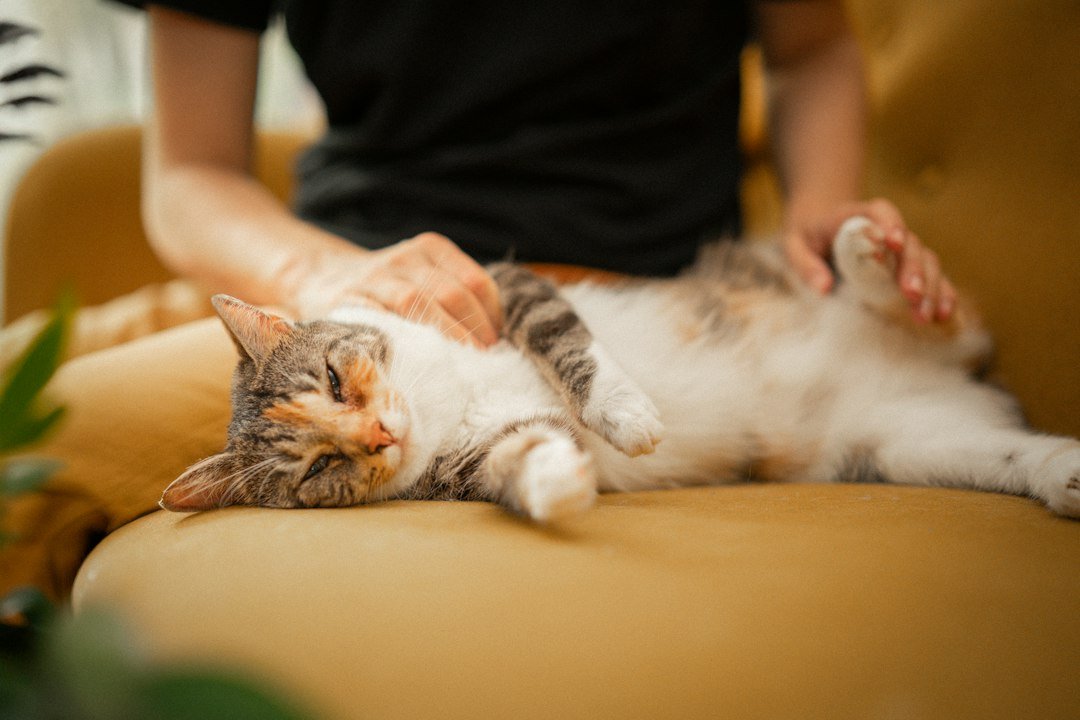
A completed example: finding a contact threshold
This is a hypothetical example, not an account of Ruby, Loki, or Coco. Nora is a healthy adult cat who approaches her caregiver on the sofa, accepts several strokes, then turns and nips. The caregiver has not noticed a sudden change, pain response, appetite change, or mobility problem.
| Session | What the caregiver tries | What Nora does | Decision |
|---|---|---|---|
| 1 | Two slow cheek strokes, then a pause | Leans back into the still hand | Offer one more stroke, then pause again |
| 2 | Four continuous strokes from head to mid-back | Tail tip flicks after the third and Nora watches the hand | Record three strokes as the current warning point; next session stops earlier |
| 3 | Two cheek strokes only | Stays relaxed, then walks away | Do not follow; the session ends successfully without a bite |
| 4 | Two cheek strokes after Nora approaches again later | Remains beside the caregiver without requesting more | Choose quiet company instead of additional touch |
The goal is not to increase the stroke count every day. It is to make contact predictable and give Nora a reliable way to end it without using teeth. A peer-reviewed review of owner-directed aggression in cats likewise recommends waiting for the cat to seek attention, starting with a single stroke, avoiding commonly disliked areas, and increasing duration only very gradually.
Separate petting bites from play bites
If the cat stalks moving fingers, grabs the arm, or bunny-kicks during an active game, the immediate context may be play rather than a low tolerance for calm touch. Keep hands out of prey-style games and use a toy that creates distance. Our play-and-put-away rule for wand toys explains how to offer interactive play while keeping strings supervised and stored afterward.
For a broader way to compare what starts and ends a session, use the observation fields in Build a Cat Play Routine Around What Your Cat Actually Does. Record petting and play separately so a bite during a high-energy game is not mistaken for a bite during quiet contact.
When a veterinary check belongs before training
Arrange veterinary advice when touch sensitivity is new; when the cat reacts to a specific body part; when there is limping, stiffness, reduced jumping, skin rippling, intense scratching, overgrooming, wounds, swelling, or a coat change; or when behavior shifts alongside appetite, thirst, litter-box, sleep, or social changes. Cornell’s overview of feline hyperesthesia describes extreme back sensitivity, skin rippling, self-scratching, vocalization, and sudden biting among signs that require professional evaluation—not a diagnosis to make at home.
If the cat is also hiding more or avoiding usual activities, compare the full pattern using our guide to hiding and meaningful behavior changes. Do not repeatedly touch a painful-looking area to “confirm” the reaction.
The practical takeaway
A safer petting session is often shorter than the human expected. Let the cat initiate, use one or two slow strokes in an accepted area, pause, and treat any early tension as a complete answer. Ending while the cat is still comfortable is not giving up—it is how you make the next interaction more predictable.
Sources and further reading
- Cornell Feline Health Center: Feline Behavior Problems—Aggression
- Feline Veterinary Medical Association: Training Techniques for Addressing Undesirable Behaviors
- Feline Veterinary Medical Association: Client Education—Cat-Friendly Interactions
- Amat M, Manteca X. Common Feline Problem Behaviours: Owner-Directed Aggression. Journal of Feline Medicine and Surgery (2019)
- Cats Protection: How to Pet a Cat
- Cornell Feline Health Center: Hyperesthesia Syndrome
Sources checked November 2, 2026. This independent educational article was not individually reviewed by a veterinarian and does not replace veterinary diagnosis, treatment, or behavior consultation.