Short answer: many short-haired cats can start with one or two brushing sessions a week, while long-haired cats often need attention every few days—and some need daily combing. The useful schedule is the one that prevents tangles, removes loose coat, and stays comfortable for this individual cat.
A calendar alone cannot choose the right frequency. Coat length, undercoat density, shedding season, age, mobility, self-grooming, and tolerance all change the answer. The goal is not to “finish the whole cat” at every session. It is to keep the coat moving freely while teaching the cat that brushing is brief and predictable.
The ASPCA’s cat-grooming guidance offers one or two weekly brushings as a general starting point and says long-haired indoor cats may need grooming every few days. Cornell’s Feline Health Center recommends daily brushing and combing when the aim is to minimize hairballs and their complications. Those recommendations are not really contradictory: one is a general coat-care starting point, while the other addresses a higher-risk outcome.
Choose a starting rhythm from the coat—not the breed label
| What you find | Reasonable starting rhythm | What to check after one week | Adjust this way |
|---|---|---|---|
| Short coat, little loose hair, comb moves easily | 1–2 short sessions a week | Is loose hair controlled? Any flakes, bumps, or bald areas? | Keep the rhythm if the coat stays smooth and the cat remains relaxed |
| Short coat with heavy seasonal shedding | Brief sessions every other day | Does each session collect less loose hair without irritating the skin? | Reduce frequency when shedding eases; stop if skin becomes sore |
| Long coat that separates easily with the fingers | Every few days | Can a wide-toothed comb pass through friction areas without catching? | Move toward daily spot-combing if tangles return between sessions |
| Dense coat with recurring tangles or a known hairball pattern | Daily, very short sessions | Are tangles smaller and less frequent? Is retching unchanged, better, or worse? | Ask a veterinarian or reputable groomer for an individual plan if problems continue |
| Senior, overweight, arthritic, or unwell cat grooming less effectively | Small areas daily or as advised | Which body zones are being missed? Is handling painful? | Arrange a veterinary assessment if reduced grooming is new or movement seems uncomfortable |
These are starting points, not prescriptions. A short-haired cat with a dense undercoat may need more help than a silky long-haired cat whose coat rarely knots. Look at the actual coat and the cat’s response.
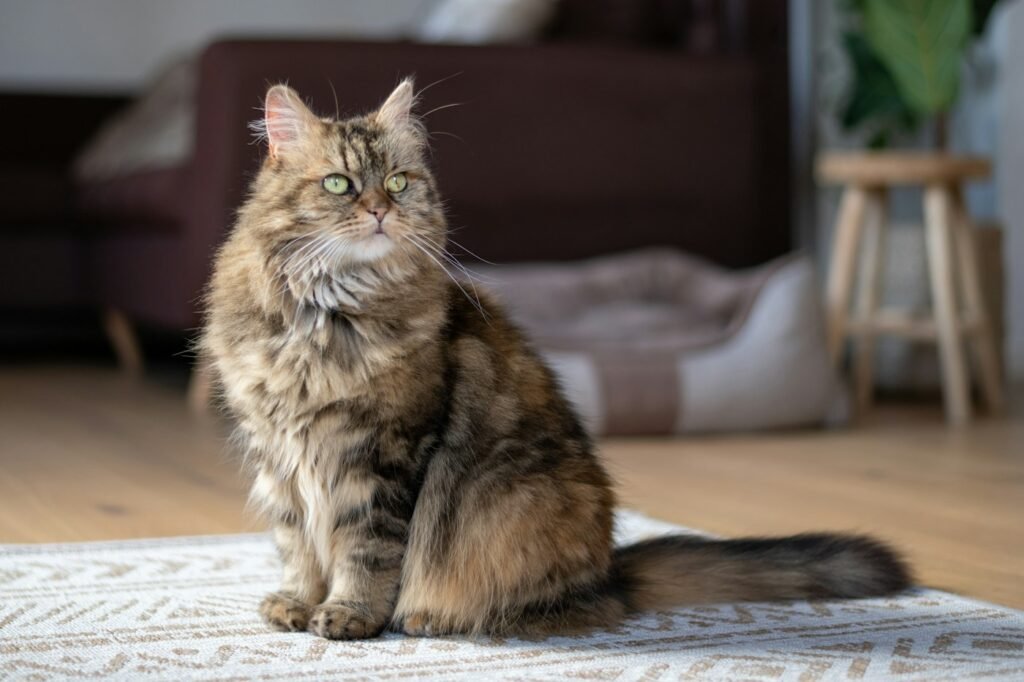
The “comb test” is more useful than counting minutes
Once a week, use your fingers first. Part the coat in several places and check whether the hair separates to the skin without pulling. Then pass an appropriate comb gently through a small section in the direction the hair grows.
- Free pass: the comb moves through, the skin looks normal, and little loose coat collects. The current schedule may be enough.
- Soft catch: a small tangle releases with fingers and gentle combing. Shorten the interval before the next session.
- Repeated catching: several friction areas tangle between sessions. Move to smaller daily zones rather than one long weekly session.
- Tight mat or painful reaction: stop pulling. Arrange help from a veterinarian or reputable groomer instead of forcing the coat apart.
The ASPCA advises professional grooming or veterinary help when a cat fights the process and either the cat or person could be injured. Tight mats can hide irritated skin and make handling painful; a “complete” home session is not worth escalating fear or injury.
A completed example: two cats, two different answers
This example is hypothetical. It is not a story about Ruby, Loki, or Coco.
| Day | Cat A: short coat | Cat B: long coat | Decision |
|---|---|---|---|
| Monday | Two-minute rubber-brush session; little loose hair; no tangles | Comb catches lightly behind both front legs | Cat A stays twice weekly. Cat B gets small friction-zone sessions daily. |
| Wednesday | No session; coat still smooth | One minute per side; tiny tangles release with fingers | Keep sessions short instead of extending them. |
| Friday | Second session; moderate loose coat after warm weather | Comb passes more easily; cat tries to leave after three minutes | Cat A temporarily moves to every other day. Cat B stops at the first clear attempt to leave. |
| Sunday review | No redness, bald patches, or repeated scratching | No tight mats; chest still catches first | Next week: Cat A every other day during shedding; Cat B daily chest/armpit checks with full-body work split across days. |
The point is not the exact number of strokes. The owners changed frequency because of evidence: loose coat, recurring friction-zone tangles, and tolerance. That produces a more useful routine than insisting every cat finish the same weekly grooming session.
Make each session easier to repeat
- Choose a settled moment. Do not start when the cat is already hiding, eating, playing intensely, or trying to leave.
- Show the tool, then touch briefly. One or two calm passes can be a complete first session.
- Work with coat growth. Use gentle pressure and one small zone at a time.
- Pause at tension. Tail lashing, skin twitching, turning toward the tool, repeated repositioning, or an attempt to leave are reasons to stop—not challenges to overcome.
- End predictably. Put the tool away and offer a reward the cat already values.
If handling practice is new, the same “touch briefly, reward, stop early” idea appears in our gentle paw-handling guide. If a professional appointment may be needed, prepare transport with the carrier-training progression rather than introducing the carrier only on grooming day.
What brushing can reveal
Brushing is also a quiet inspection. Before and during a session, look for bald patches, wounds, unusual bumps, redness, flaky skin, fleas or flea dirt, and areas the cat obsessively licks or scratches. The ASPCA advises veterinary evaluation for abnormal hair loss, redness, bald patches, persistent scratching, licking, or biting.
| Observation | What not to assume | Next step |
|---|---|---|
| More loose hair during a seasonal change | That the cat automatically has a disease | Increase short sessions and check that the skin remains normal |
| New bald patch, redness, scabs, or persistent itching | That brushing caused the underlying problem | Stop irritating the area and arrange veterinary assessment |
| New reluctance to groom or be touched | That the cat has “become difficult” | Consider pain or illness and discuss the change with a veterinarian |
| Repeated unproductive retching, lethargy, or refusal to eat | That it is “just a hairball” | Seek veterinary care without delay |
Cornell notes that swallowed hair usually passes through the digestive tract, but a large hairball can occasionally obstruct it. Cornell also cautions against giving laxatives or hairball diets for a suspected obstruction without veterinary approval and supervision. Repeated unproductive retching can also be confused with other gastrointestinal or respiratory problems.
The useful answer changes with the cat
Start modestly: one or two weekly sessions for an easy short coat, every few days for many long coats, and shorter daily work when tangles, shedding, age, mobility, or hairball risk justify it. Then adjust from what you can actually observe.
A successful brushing schedule leaves the coat easier to comb, the skin visible and comfortable, and the cat willing to return next time. If achieving those outcomes requires restraint, pain, or a fight, the next step is professional help—not a longer home session.
Sources and further reading
- ASPCA: Cat Grooming Tips — general brushing frequency, coat inspection, long-hair care, skin warning signs, and when to seek professional help. Checked October 5, 2026.
- Cornell Feline Health Center: The Danger of Hairballs — how hairballs form, higher-risk patterns, brushing, and veterinary warning signs. Checked October 5, 2026.
- Cornell Feline Health Center: A Hairy Dilemma — coat length, shedding, hairball risk, and when retching needs veterinary attention. Checked October 5, 2026.
Editorial note: This general educational article was written and sourced by Ruby Cat Life. It has not been individually reviewed by a veterinarian and does not replace veterinary diagnosis or a personalized grooming plan.